


The Bank of Papua New Guinea (BPNG) are Papua New Guinea's Central Bank. BPNG is an independent central bank which was first established prior to Papua New Guinea's independence on 1 November 1973. An important aim for the Bank is to support the expansion and diversification of the financial sector to provide competitive access to financial products and services for all PNG citizens. Financial inclusion is a priority for the Bank, and they strive for cost-effective and fit-for-purpose financial services delivered to all, including those in rural and remote locations of Papua New Guinea.
Pebble IT has been the Bank's Oracle MSP since 2010 and one of our initial initiatives was to improve the Bank's Oracle systems, which was achieved with an Oracle Exadata in 2015.
The Bank's Exadatas had served the Bank well since their implementation in 2015. The Bank saw the replacement of the Exadatas as a strategic opportunity to understand whether continuing the Exadatas at the Bank was the right choice. Whatever the outcome, the solution had to be well known and established, the Bank would not entertain unproven solutions; high-performing and extremely resilient.
Due to this pending requirement, the Bank also decided in consultation with Pebble IT to have a broad review of their infrastructure and systems to understand where focus would benefit the Bank.
The initial engagement that Pebble IT undertook with the Bank was a cutdown version of Pebble IT's "System Transformation" methodology that has documented processes for revealing and analysing an organisation's IT systems and prioritising focus to deliver value for money outcomes. Some excerpts from the documentation used in the BPNG exercise is contained below:
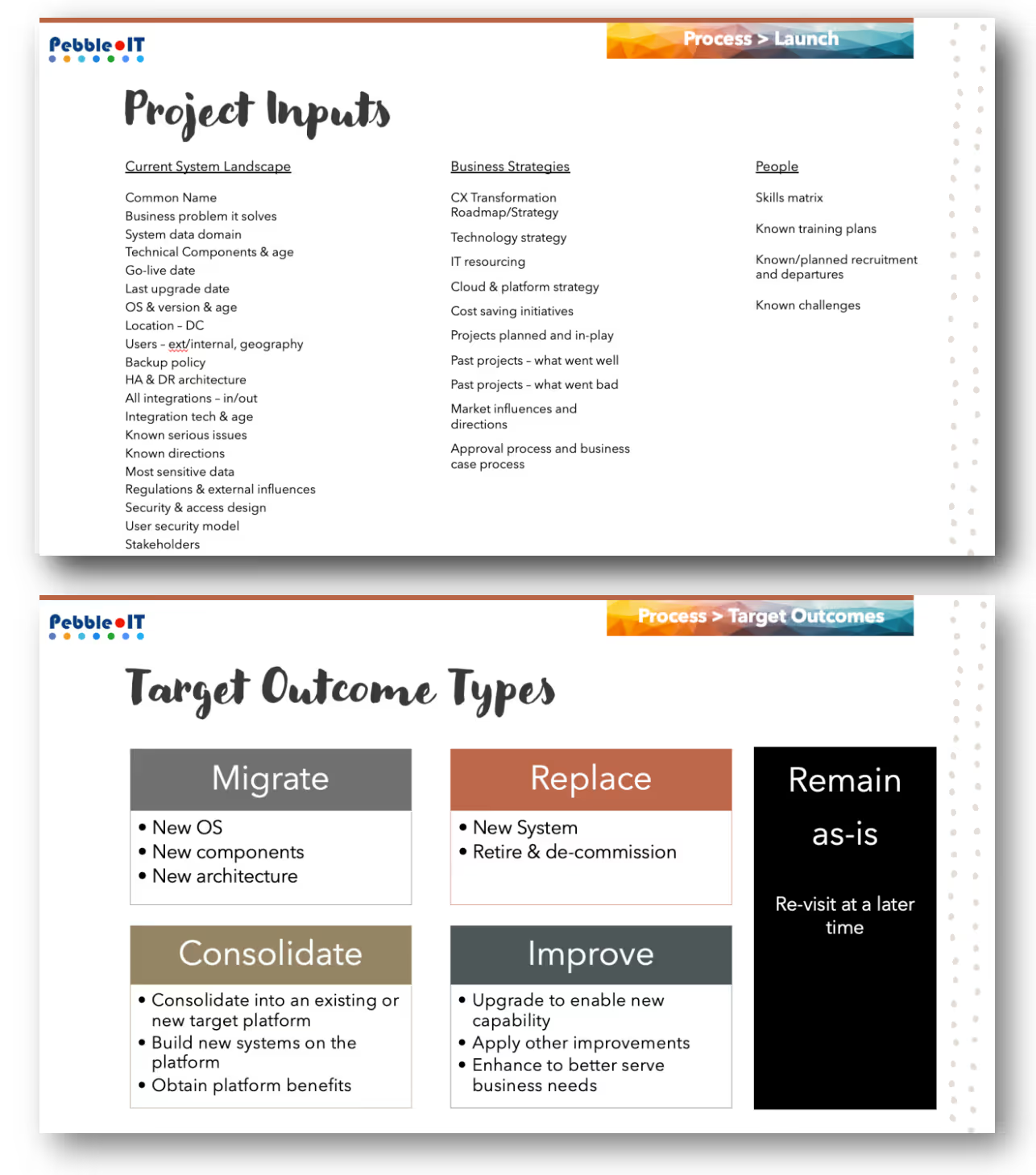
The System Transformation workshops guided BPNG through a structured approach rather than scatter-gun based on people's thoughts at the time which may be biased or reflect recent events which can result in a missing a strategic outcome. The scope included all infrastructure, data centres and the entire software stack including operating systems, virtualisation as well as databases and applications. The outputs of that exercise is not shared here, but it confirmed with the Bank that there was a significant opportunity available to the Bank to introduce more versatile infrastructure to support solutions beyond the Oracle Enterprise database constraints that the Exadata's represent.
With the priorities understood, Pebble IT presented multiple alternatives to the Bank each with their own advantages and disadvantages, a 5-Year Total Cost of Ownership comparison and insights onto how each solution would fit in with a larger IT strategy.
Change is everywhere and Papua New Guinea is not exempt from that, the Bank has a strong desire to remain competitive within international markets and strives to ensure that their IT is part of that vision with security and resiliency being their highest priorities. The process that we facilitated with the Bank delivered change, but gave insights that underpinned the justification for change and help shape what is possible in the near future.
The Bank was able to build a clear business case showing the cost comparison and benefits of each solution. The Dell Powerflex was the chosen infrastructure for the Bank, and the key reasons were:
This was confirmed with hands-on demonstrations of Dell PowerFlex with Dell in Sydney, and similar transition stories shared that gave BPNG the confidence required that it was developing a beneficial relationship with a global vendor that would genuinely partner with both Pebble IT and BPNG to ensure customer success.
The PowerFlex has proven to be extremely successful at the Bank and this has led to moving into subsequent execution of IT strategies to consolidate infrastructure and workloads.
Pebble IT congratulates the Bank on developing the vision that has led to the Dell PowerFlex being chosen and implemented and we are grateful that we have been a crucial part of the Bank's ongoing success. Contact us to help you decide whether to remain on your current platform or change to a more suitable platform including Public Cloud.